
Tiny Power Supplies
Opinion by Ralph Grabowski
(I purchased all products described here.)
I recall a fellow instructor at the local technical collage showing off to me his brand-new, high-power, 17” Dell workstation-style laptop. Then, he unhappily also showed me the monster-size power brick it came with. It truly was the size of a brick, and heavy as one, too.
Then the GaN revolution occurred. Gallium nitride allows us to have tiny chargers, tiny because they need fewer components and produce less heat, so they can be manufactured with fewer heatsinks and be made more compact.
I got a 65W model with three ports: one USB-A and two USB-C. Being small, it’s the ideal travel charger, as it handles my cell phone, tablet, and laptop computer at the same time. Imagine: a laptop charger a third the size of my fist!
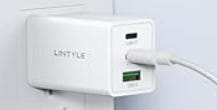
Tiny charger handles cell phone, tablet, and laptop at the same time
Scharge Pixel 100
More recently, I bought a second charger as insurance, should the first one get lost -- no charger on a multi-week trip would be a disaster!
Scharge is a company that does interesting design ideas. If it were Apple, the tech world would be swooning; but it’s not, so the world isn’t. For instance, it has see-thru power banks, of which I bought one, but then was disappointed to find my laptop wouldn’t charge from it. Also, it’s too heavy to haul around all day long in a backpack. Still, it looks cool.
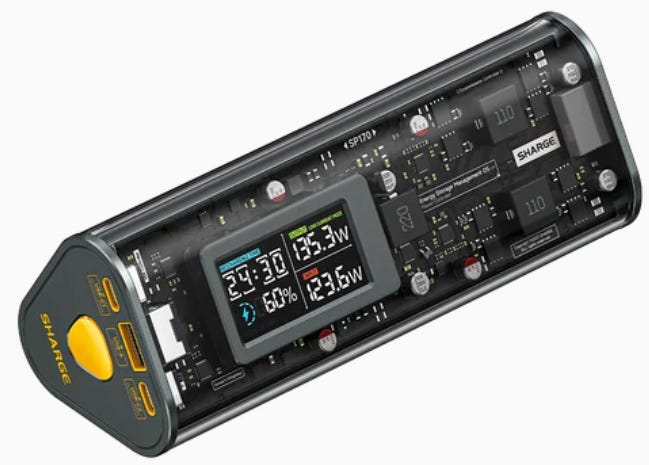
See-through power bank with display
I next bought from Scharge the Pixel 100 ($60) charger, “Pixel,” because of the built-in pixelated display, and “100,” because that’s the maximum combined power output (in watts). Scharge says the look mimics Braun’s T3 Bauhaus-style radio from 1958.
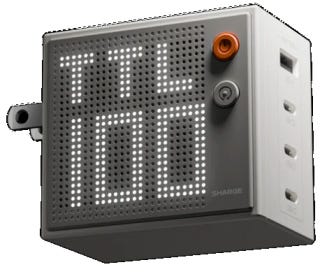
Scharge's Pixel 100 charger reporting power output
It charges four devices at once. The pixelated display report the number of watts sent to each port in use: A1 = USB-A; CII = USB-C #2; TTL = total power, and so on. The orange button dims and turns off the display, while the white button with each press rotates the display by 90 degrees.
I picked the 100W model over the 140W model, because the 140 model has no USB-A port, and anyhow it costs $20 more. Although the extra watts output a faster charging level, 28V@5A, I tend to charge my devices overnight, so the extra charging speed isn’t useful to me.
Unlike the power bank, this charger has worked well for me.
https://sharge.com/products/pixel-100-140-charger
USB-C Power Communications
Electronic devices with USB-C ports communicate with each other during the split-second we plug them in. When we plug a phone into a power supply, the power supply reports its capabilities, while the phone tells the power supply what levels of voltage it can accept. All this happens in the split second it takes us to plug in the phone for recharging.
Voltage is delivered by the charger, current is drawn by the phone. Voltage is like the number of lanes on a highway; more lanes = more volts. Current (amperes) is like the speed at which the cars are driving; faster speed = more current.
Splitting Power Levels
Modern power supplies output a variety of combinations of volts and amps, but are limited by the overall wattage. Watts combines the two: voltage x current. Watt-hours tells you how long a battery can last.
For example, a 65W power supply can output 65W when one device is connected to the USB-C port, but then splits the power 45W/20W when a second device is connected.
USB-A ports output less power. I use them when I want a device to charge slowly, which helps preserve the battery. Fast charging shortens the life of batteries.
This chart gives the watt outputs for combinations of attached devices. It reads “Max” for each port, as the phone might not draw that much power.
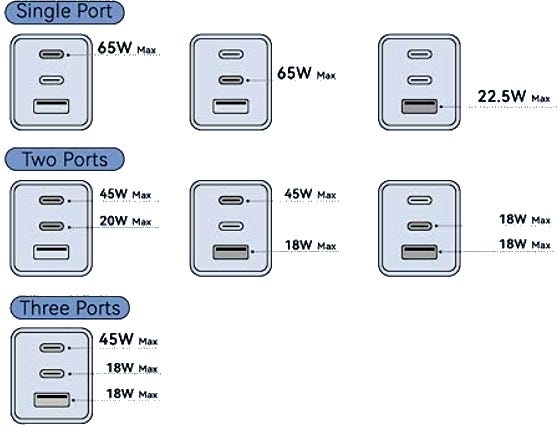
Rounded ports are USB-C and can output more power; rectangular ones are USB-A and output less power (image credit Lintyle)
When you plug a second device into a multi-port charger, you might notice the first device stops charging briefly. The charger halts its work for a moment to assess the new situation, and then assigns different power levels to each output.
The analogy our Electricity teacher in high school told us was voltage is the diameter of a water hose, and amperage the water pressure. Never made sense to me.
The number of lanes is more analogous to conductivity (1/resistance) in an electronic circuit. A better analogy for voltage could be the downhill slope of the road.